

Click Click Click Pwoof

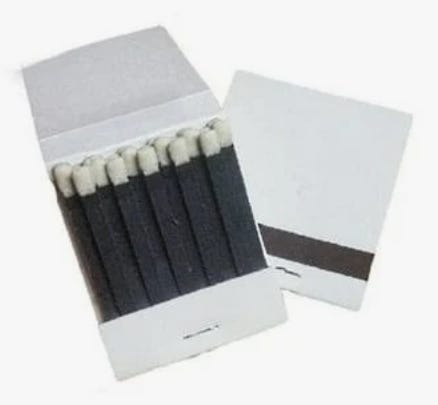
White matchbooks in all manner of disrepair were strewn throughout the kitchen of my childhood apartment. They were folded or unfolded, white as snow or stained with wear, strike strips virginal or wet and scraped beyond function, white-tipped matches lay parallel and uniform, waiting for their big moment to spark like dancers auditioning for a Broadway show.
The cautionary click click click of the open gas line didn’t exist when I was a kid. I would twist the oven dial to 350 and walk away to dump the box of Dunkin Hines brownie mix into my parents’ large wooden salad bowl. I’d climb onto the counter, searching for oil in a sticky upper cabinet, and suddenly remember that the oven needed to be lit. I’d quickly fish a matchbook off the counter, strike once or twice to ignite the tip, open the oven door, and throw the match at the hissing hole at the bottom of the cavity. BOOM! Every single time.
All the kids in my neighborhood had that eyebrow-erasing experience. It wasn’t deadly, it just smelled that way.
I was terrified but not subdued. The application of heat to transform the simplest powders and liquids into a sugary masterpiece was too extraordinary to renounce. I was hooked.
As a chef whose business revolves around cooking in strangers’ kitchens, the click click click of a client’s stovetop is a call to action. It’s thrilling. It’s titillating. It’s foreplay. No matches necessary for this show. When I hear the pwoof of the gas lighting, I know we’re in business.
The house was large and old, with sizeable acreage that I think included a horse-filled stable.
“Hi, I’m Alison, your chef.” I timidly announced to the woman who answered the door.
I was embarrassed by my small but bulging biceps, flexed from carrying bags of food and a William’s Sonoma showroom amount of equipment.
“Oh my!” She exclaimed, possibly impressed with either my muscles or my tenacity to carry so much at once. “It’s nice to meet you, Alison. Can I help?”
It’s much safer for me to schlep pots and pans to clients’ homes than to hope they have what I need. Also, I have a relationship with my equipment. Every single time I cook, it’s a new menu, new kitchen, new clients, and I’d be lost if I didn’t have my trusty tools with me. They’re like my family (even more dependable than my family sometimes), and I can always rely on how they respond to heat, fat, and time.
“No, thanks, I’ve got it,” I replied and followed her into the wide, open kitchen. Her family was mingling around the breakfast nook, and all rose to greet me.
I shook and nodded and grinned and then began to unload proteins and vegetables into the fridge, squirt bottles of sauces onto the counters, cutting boards and seasonings nearby, and sheet, fry, and sauté pans on the stovetop.
“Oh… you’ll be using the cooktop!” The daughter’s eyes grew to double their size, and she looked at her mother to communicate something silently.
Clients are always sheepish about their own kitchens. I get “Sorry, this is so old,” or “We tried to clean it,” or “Someday we’ll redo our kitchen” in well-adorned homes all the time, so I’m used to this kind of reaction when I unpack.
It was a gas 5-burner stovetop from the (I’m guessing) early 80’s.
The daughter continued, pointing to the low-mounted oven on the wall behind me, “The oven gets a lot hotter than it’s set to and will burn your eyebrows with the heat when you open the door.” Everyone in the room seemed to second that statement with a grunt or chuckle. “And the cooktop is kind of old.” The crowd went silent.
The dad stepped in, “She’ll be fine,” (not sure if he was referring to me or the cooktop as a “she” like a trusty, old schooner.) He leaned in and whispered, “The middle burner is the best one.” And then winked like we were old buddies.
“Oh, um, thanks. Don’t worry about a thing!”
The middle jet was a double-ring gas burner, obviously the workhorse of the 5, with a wider space between it and the other burners. I turned the knob and with a click click click pwoof it lit quickly. With a cocky grin, I put my hand up to ease their fears. “In my 30-plus years of cooking in people’s homes, I’ve had some rough situations. Your beautiful kitchen is going to make my job a piece of cake!” [Hold for laughter, because cake.] “Stay tuned for appetizers!”
I declared myself an early winner with a beaming smile and a flaming burner.
This was an 80th birthday dinner celebration for 10, with apps for the adults while the girls played tag on the great green meadow beyond. It was a picture-perfect day with everyone grinning on the lanai, cocktails in hand, and peals of laughter from the kids.
I went into auto-mode, quietly setting up timelines and small workstations for each course. I put a small pot of the beef stock I had made for the final sauce on a back burner to reduce a little more.
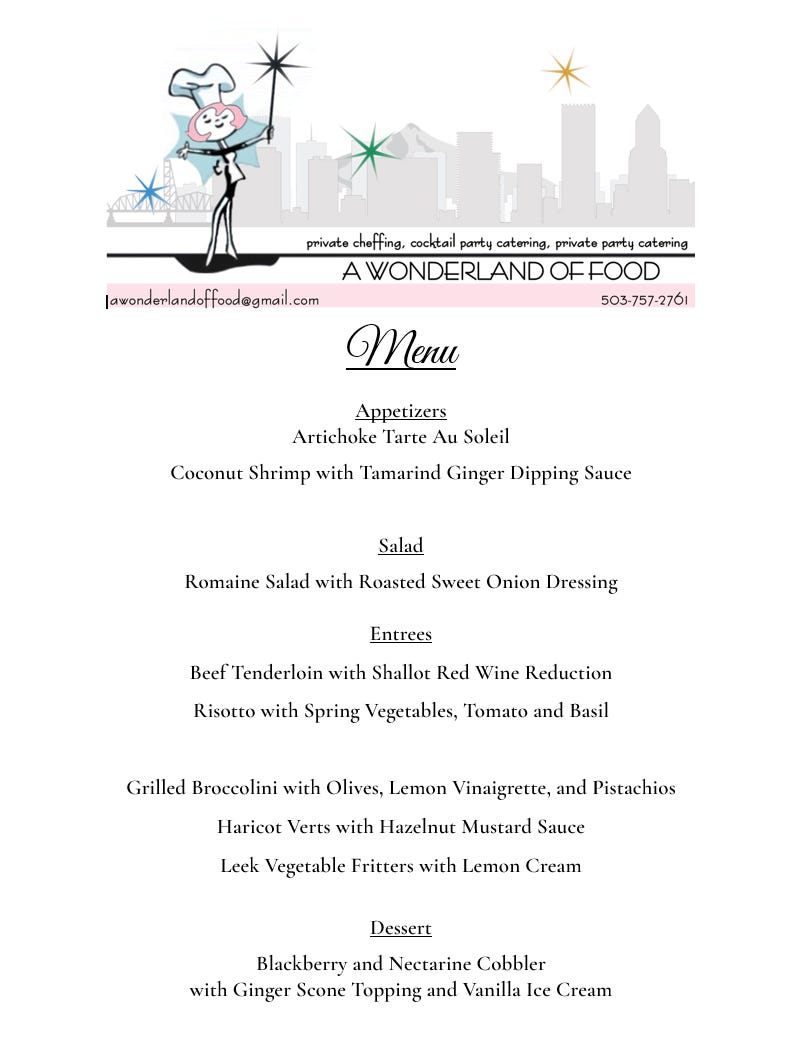
My server arrived, and I talked her through the menu:
She made sure drinks were full, and we began to serve the appetizers.
They started with the artichoke tarte au Soliel, which is always an impressive work of art and flavor.
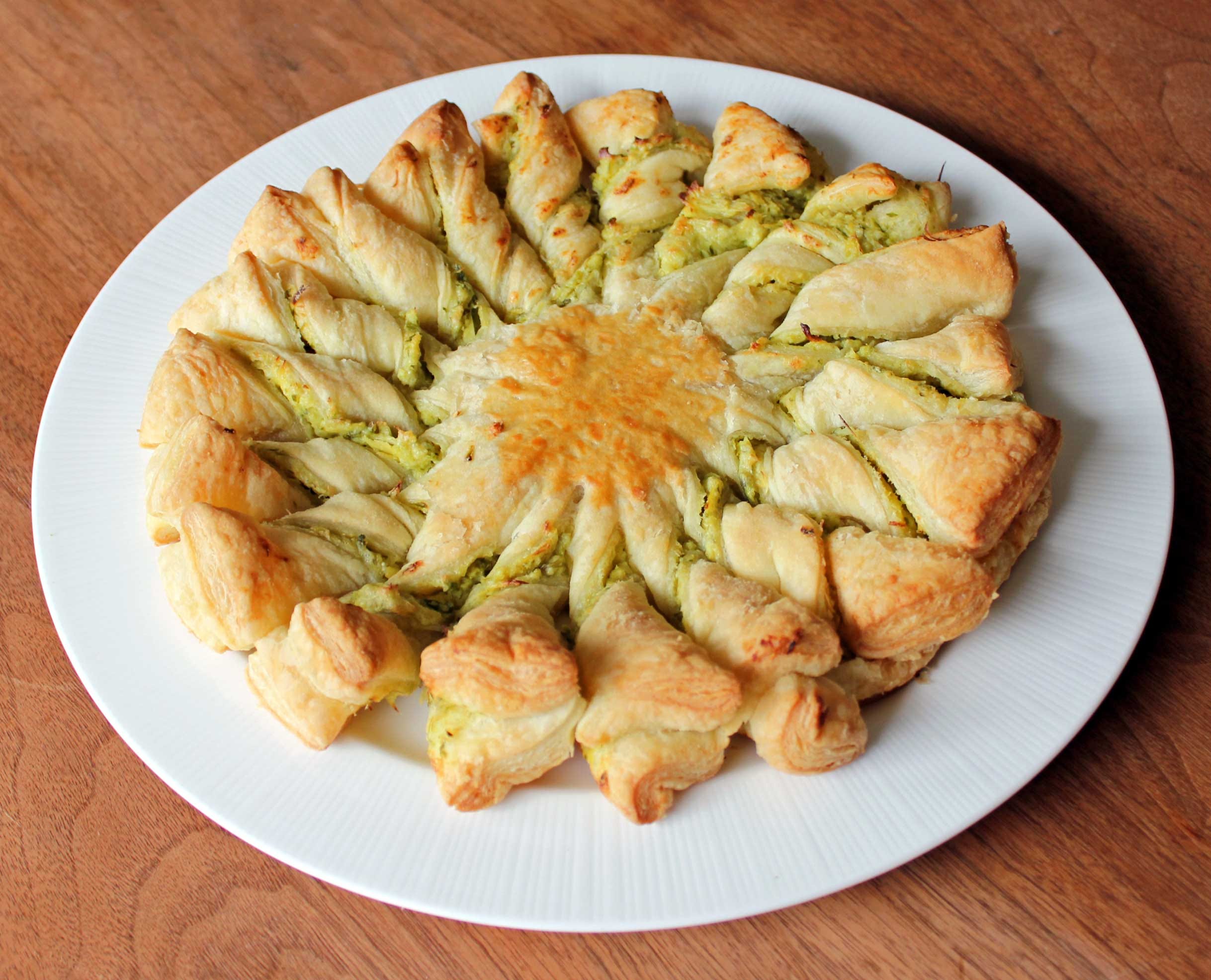
The oven did run hot, but not so hot that it burned anything, not even my eyebrows.
They moved on to the coconut shrimp with tamarind ginger dip. I could see smiles through the sliding glass door and turned back to the kitchen with one too.
I double checked the stock, which strangely hadn’t reduced at all, even though the burner was definitely on. I turned it up, and long, 3-inch yellow flames licked the sides of the small pot. “Hrm,” I felt my heart beat boom boom in my chest, as if my body knew something my head still hadn’t learned. It’s fine, I thought to myself. We still had a while before they came inside for the salad course.
I focused on setting up the risotto, one of the side dishes for the filet. Checking the clock, I was right on track. Oil, a little butter, onions, wine, arborio, and stock. It’s a slow, beautiful build of flavors and textures. Blistered cherry tomatoes, spring peas, lemon, and basil would join the party in a little while. Then handfuls of parm… but not yet. Soon, soon.
I set up the broccolini to roast in a shallow bath of oil, lemons, and olives, and the leek fritters, which I had fried earlier, to heat on a sheet pan. The tied tenderloin beef filets had been salted long ago and then sprinkled with a little brown sugar to help caramelize the sear.
I needed to move the risotto onto another side burner because the arborio rice didn’t seem to be absorbing the chicken stock at all, but the other burners wouldn’t light. Click click click click click click click nothing. I shook my head and felt a little short of breath.
The stock on the back burner hadn’t reduced at all.
I put my trusty All-Clad pan onto the middle burner. It’s got to get raging hot before I set those filets in. It has to be screaming to make the Maillard process occur. Click click click pwoof thp.
What the fuck is thp!?!
I tried again, click click click pwoof thp.
The outer ring ate the flame as soon as something was on top of it. It put itself out. The inner burner had the heat of an aim and flame, so there was no heat coming out of the workhorse burner.
Click click click pwoof thp. I took the pan off the burner, and both the rings ignited, but when I put the pan on top: thp. I left the pan on that middle burner with whatever flame there was, hoping for the best.
Salad had to be dressed and plated. That was the next thing on the prep list in my head, which, for some reason, I couldn’t intervene with. I was a robot. I couldn’t stop and say firmly, “Alison, there’s something wrong with this stovetop. Find another way to cook the food.” I just kept moving forward like a goddamned AI chef.
Salad left the kitchen. It was beautiful. And I thought, everything is going to be fine.
Except that the risotto was a special kind of al dente that’s also called raw. I stirred and hoped. Every burner was on high, and nothing would cook.
My AI chef alter ego decided it was time to sear the steaks because that’s technically what time it was. I made a plan that could not be altered because I was no longer human, just in human form.
The steaks didn’t smoke, they didn’t sizzle, they didn’t make a sound. They just lay there, steaming. And I knew I had destroyed these beautiful filets in that lukewarm pan. I saw the grey instead of the brown. There would be no crust.
In a desperate moment, I shoved the pan into the oven, which I knew was very hot (and was what I should have done to get the pan hot first), but I couldn’t see it. I wasn’t aware enough to change my route.
I stirred that risotto while empty salad plates came back. I knew the table could wait a bit between courses, but not long. Come on, come on, come on, risotto. I took a bite. Almost. Come on, come on, come on.
Click click click pwoof thp.
I took the steaks out of the oven at the right temperature, removing the meat to another sheet pan and placing the pan on the cooktop to try to deglaze with the wine and stock. There would be no dancing bits reduced into glossy sauce on this day. Everything just lay there, wet and lifeless.
I cursed and sweated and lost feeling in most of my body. My server nervously ran in a circle around me, trying to help, but knew there was nothing anyone could do. “It’s going to be ok, Alison, they’re really happy out there.”
I plated the risotto, which, when I tasted again, seemed less crunchy, but still not the soft creamy forkful that it should be. I plated the broccolini and the fritters. The steaks were set onto each plate with a drip, not a drizzle of wet “sauce”. I desperately sprinkled some chopped parsley to hide the grey.
The plates left the kitchen, and I felt my emotions rise. No, no tears yet. I would not let that happen when there was still another course to go.
I turned the oven down a bit and gently placed the cobbler inside. I drowned my sponge in soap and slipped into a healing meditational dishwashing trance. I wiped down the counters and the soupy spaces between the burners. The feeling in my arms and head returned. I was still alive.
The plates came back empty, or with requests to pack up what was left for them to eat the following day.
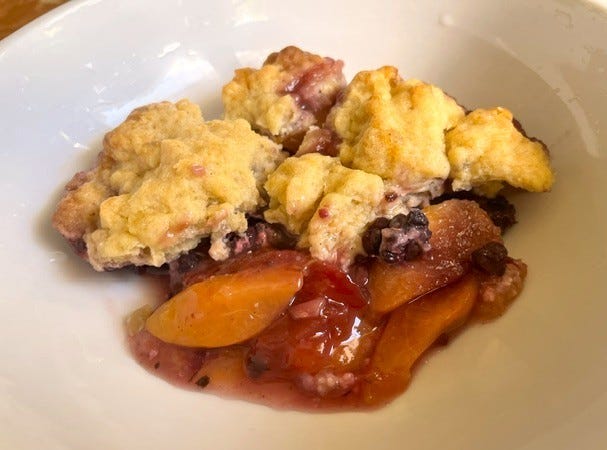
We served the nectarine blackberry cobbler with ginger scone topping à la mode, and they squealed with joy. Honestly, there were cheers. I could hear them from the kitchen. I stood there listening to the joy, alone in shock.
I always say to my staff, “Serve a breathtaking dessert, leave them with a sparkling kitchen, and they’ll forget the rest!” I never knew how true that was until this fateful day.
So here is my recipe for nectarine and blackberry cobbler with candied ginger scone topping. May all your desserts be luscious and your burners hot!
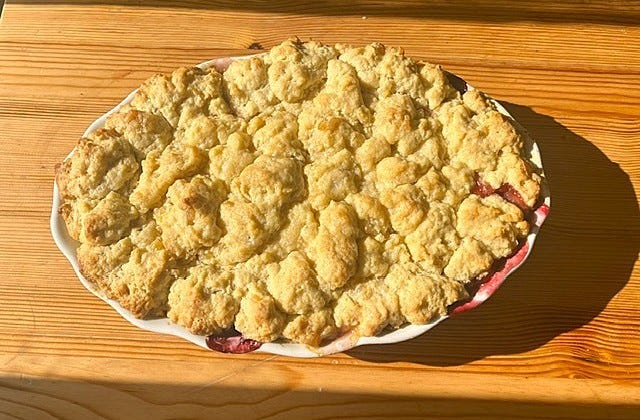
Save the Day Nectarine and Blackberry Cobbler with Candied Ginger Scone Topping
Makes enough for 8
Ingredients for the cobbler
· 5 cups (this is an average of 8-10 nectarines, depending on how big they are) peeled and sliced nectarines
· ½ cup sugar
· 2 teaspoons cornstarch
· 1 teaspoon vanilla extract
· 1 teaspoon almond extract
· ½ teaspoon salt
· 1 pint blackberries
1. Preheat the oven to 375 degrees.
2. Toss the nectarines with the sugar, cornstarch, vanilla and almond extracts, and salt.
3. Set in a 2-quart baking dish and bake for 15 minutes, while you make the topping…
Ingredients for the ginger scone topping:
2 ¼ cups all-purpose flour
1/3 cup sugar
1 tablespoon baking powder
1 teaspoon salt
1 teaspoon ground ginger
12 tablespoons chilled unsalted butter, cut into small pieces
¾ cup plus 2 tablespoons whipping cream
2/3 cup crystallized ginger, diced
Blend flour, sugar, baking powder, salt, and ground ginger in a large bowl.
Using your fingers, smush the butter into the flour mixture until the butter looks like coarse meal.
Make well in center; add 3/4 cup cream. Using a fork, stir until just moist. Mix in crystallized ginger. Adding a little flour to the bowl, knead gently for a few turns.
Once the nectarines have cooked for 15 minutes, stir the blackberries into the baking dish with the nectarines. Pat clumps of dough over (I pull pieces of dough that are an average of 2 inches around) the top of the baking dish to cover all the fruit.
Brush dough with the remaining 2 tablespoons of cream.
Bake for 30-35 minutes until the dough is puffy and golden brown.
I LOVE reading your adventures in chef-ing! This dessert sounds delicious!
Once upon a time (in Georgia) I prepared loaves of bread to bake. Uh, oh, oven not working at all. We had just made dinner in the Weber kettle. I put in a bit more coal and put the loaves in the kettle. They were just fine. Maybe a bit smoky.
Excellent adventure. Looking forward to trying the tart and the cobbler.